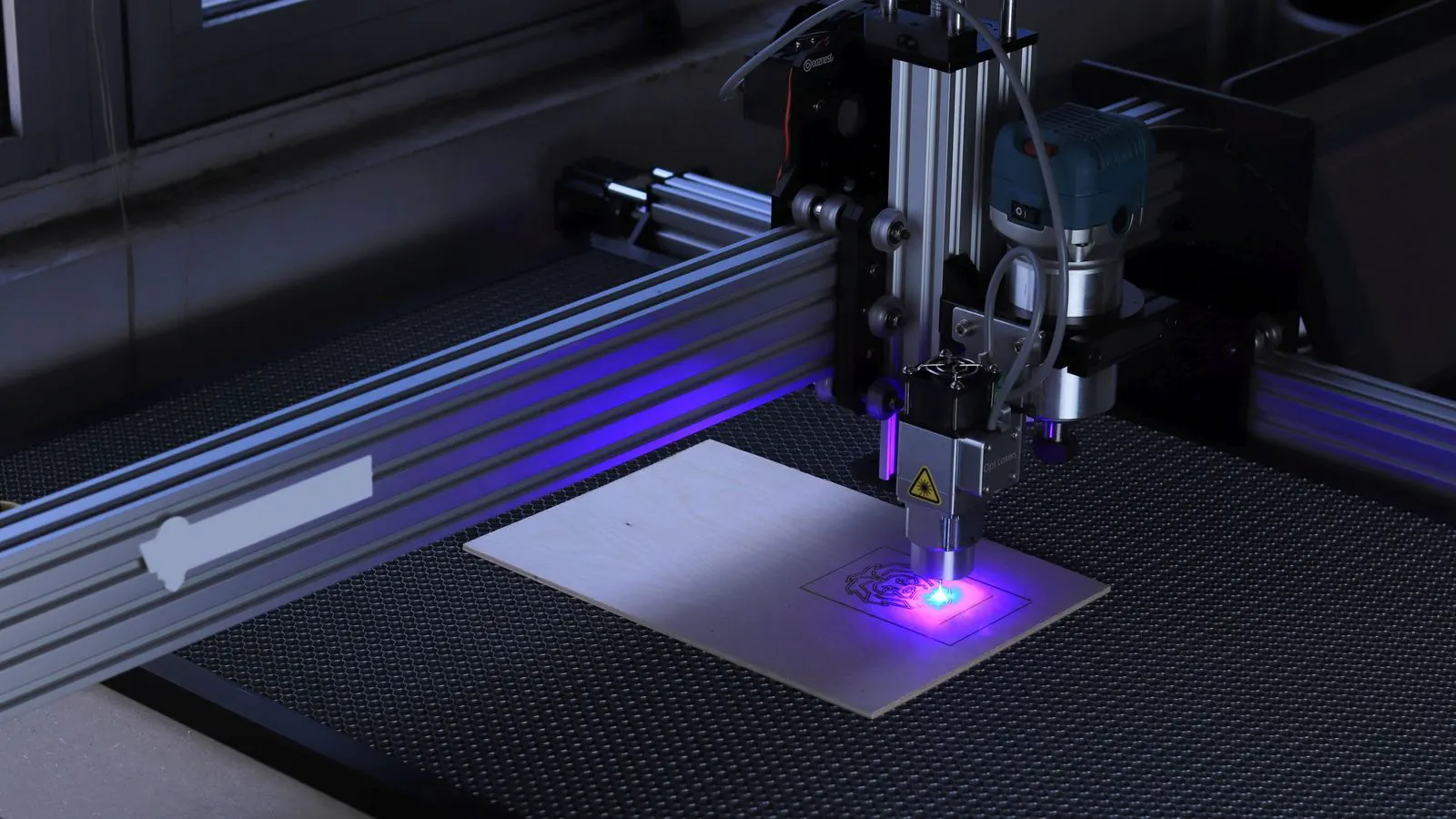
Laser cutting offers high precision and complex geometry, while press brakes bend flat stock into formed shapes. Choose laser for intricate cuts and tight tolerances. Select press brake for economical bending of larger panels.
- Laser cutting excels at precision, complex shapes, and thin gauge work.
- Press brake bending is efficient for forming large flat panels into angles and boxes.
- Edge quality differs significantly between the two processes.
- Material thickness and geometry determine the best process choice.
The Core Distinction
Laser cutting and press brake bending solve different problems in sheet metal fabrication. A laser head removes material to create a flat, two-dimensional shape. A press brake uses mechanical force to bend flat stock into a three-dimensional form.
Most fabricated parts require both steps. The part starts as a flat sheet. The laser cuts the outline and any internal features. The press brake then forms the bends.
Choosing between laser vs press brake often means understanding which step drives your cost and quality requirements. The laser defines the geometry. The brake defines the form. When you send a drawing to a fabricator, the cost and schedule are usually determined by which of these two operations is the bottleneck.
Consider a simple shelf bracket. The laser cuts the flat profile, including slots for fasteners and countersinks for screws. The press brake then forms the two flanges. If the bracket has a complex perforation pattern, the laser work time increases. If the bracket has a very long bend line, the press brake work time increases. The final cost reflects both.
When to Pick Each Process
The selection depends on geometry, material thickness, and tolerance requirements.
| Option | Best for | Limitations |
|---|---|---|
| Laser Cutting | Complex geometries, tight tolerances, thin gauge, high precision | Thick material, large sheets, high volume low complexity |
| Press Brake Bending | Large panels, simple bends, high volume, thick gauge | Complex 3D shapes, tight inside corners, thin gauge |
| Combination | Most fabricated parts, boxes, enclosures, brackets | Process changeovers, fixture requirements, alignment checks |
Laser cutting handles intricate patterns that a press brake cannot form. Think of a perforated enclosure or a part with many small internal features. The laser cuts these in one pass. The tool head follows the vector path defined in the nesting software. It does not require physical tooling for each shape. This makes it ideal for parts with changing geometries or small batches.
Press brakes handle the bulk forming. A large flat panel becomes a channel, a box, or a tray. The bend lines are defined by the die and punch. The operator selects the correct die based on the material thickness and the desired bend radius. The punch force is set to achieve the target angle.
A typical enclosure uses both. The laser cuts the flat pattern. The press brake forms the flanges. The flat pattern is calculated to account for material stretch during bending. If the flat pattern is wrong, the final part will not meet the required dimensions.
Edge Quality and Finish
Edge quality matters for assembly and appearance.
Laser cutting produces a clean, smooth edge. The heat-affected zone is minimal on thin materials. On thicker stock, the edge may show some discoloration or a slight taper. The quality of the edge depends on the gas used for cutting. Nitrogen often provides a cleaner finish on stainless steel. Air is cheaper and works well for carbon steel. Oxygen is used for thicker carbon steel but creates a rougher edge.
Press brake bending leaves the edge flat. The bend creates a radius, not a cut. The edge quality depends on the material condition and the tooling. The bend radius determines the stress distribution in the material. A tight radius requires more force and can cause cracking in some materials.
For parts where the edge is visible, laser cutting offers a cleaner finish. For structural parts, the bend quality matters more than the edge finish.
Check your drawing requirements. Some parts need deburring. Some need a specific edge break. A deburr removes the burr left behind by the laser. An edge break reduces the sharpness of the edge for safety or assembly. The drawing should specify these requirements. If they are not specified, the fabricator may apply their standard practice, which may not meet your needs.
Tolerance and Precision
Laser cutting maintains consistent tolerances across complex shapes. The CNC control holds position within tight limits. The laser head moves in X and Y coordinates. The software accounts for thermal distortion and material movement.
Press brake bending tolerances depend on tooling, material, and operator skill. The bend angle is critical. A small error in angle creates a large deviation at the part end. If a 90-degree bend is off by one degree, the part will not fit in its housing.
For tight tolerances, laser cutting has the advantage. For bend angles, press brake accuracy depends on the die selection and material stretch. The material stretch varies with thickness, grade, and bend direction. The fabricator uses a bend deduction table to calculate the flat pattern. This table is specific to the material and tooling.
If your drawing calls for tight positional tolerances, plan for laser cutting. If the tolerance is on the bend angle, focus on press brake setup. The press brake operator must set the bend stop accurately. The tooling must be clean and aligned. Any deviation in the die or punch position affects the final part.
Material Thickness and Cost
Laser cutting cost scales with cut length and material thickness. Thin stock is fast. Thick stock is slower and more expensive. The laser power must be sufficient to cut through the material. Higher power lasers can cut thicker stock faster, but they are more expensive to operate.
Press brake bending cost scales with bend length and part complexity. A long bend on a large panel costs more than a short bend on a small part. The tonnage required for the bend depends on the material thickness and width. A press brake with higher tonnage can handle thicker material and wider bends.
For thin gauge, laser cutting is often the primary cost driver. For thick gauge, press brake bending may dominate.
Review your material bill. Identify the dominant cut and the dominant bend. That tells you where the cost pressure is. If the part has a long perimeter and many small holes, the laser cost will be high. If the part has a few long bends and a simple outline, the press brake cost will be high.
Practical Considerations for Your Part
Look at your part geometry. Count the bends. Measure the cut length. Check the material thickness.
- Identify the flat pattern.
- Count the internal features.
- Measure the bend lengths.
- Check the tolerance stack.
- Review the material grade.
A part with many small bends may need a different tooling setup than a part with one large bend. The number of bends affects the press brake cycle time. Each bend requires a setup step. The more bends, the longer the setup time.
Ask the fabricator to confirm their laser capability for your material. Ask about their press brake tonnage and die options. The laser should be able to cut your specific material thickness. The press brake should have the tonnage to bend your material without excessive stretching.
Common Mistakes in Process Selection
Buyers often assume laser cutting is always better. It is not.
Laser cutting is slower on thick material. Press brake bending is faster on large flat panels.
Another mistake is ignoring fixture requirements. A complex part may need a custom die. That adds setup time. A custom die is a one-time cost. It pays off if the part is produced in volume.
Check the drawing for bend direction. Some parts cannot bend in one direction without a tooling change. If the part has bends in both directions, the fabricator may need to flip the part between bends. This adds handling time.
Confirm the material grade. Stainless, aluminum, and carbon steel behave differently under bending force. Each material has a different springback. Springback is the tendency of the material to return to its original shape after bending. The fabricator must account for springback in the bend deduction.
Final Selection Criteria
Use these questions to decide.
- Is the shape too complex for simple bending?
- Are the tolerances tighter than press brake capability?
- Is the material thickness outside the laser’s optimal range?
- Is the part volume high enough to justify dedicated tooling?
- Does the edge finish require a specific quality?
The answer points to laser, press brake, or a combination.
Review your RFQ. Make sure the drawing clearly shows bend lines and cut lines. A misalignment here causes rework. The drawing should show the bend direction and the bend radius. It should show the flat pattern or the 3D model.
Check the fabricator’s capacity. A small job may fit on a standard laser. A large job may need a specific press brake. The laser should be able to handle the sheet size. The press brake should have the ram length to bend the entire width of the panel.
Confirm the lead time. Laser cutting and press brake bending have different setup times. Plan the sequence. Cutting before bending is standard. Bending before cutting can cause distortion. The laser head may not be able to cut through a bent part easily.
Verify the edge treatment. Some parts need deburring. Some need a protective coating. The coating protects the part from corrosion and handling damage.
Ask about the quality checks. Laser parts get a visual inspection. Press brake parts get an angle check. The angle check uses a protractor or a digital angle gauge. The measurement is taken at multiple points along the bend line.
Confirm the documentation. The final report should show the process used for each feature. The report should include the inspection results.
Review the cost breakdown. Separate the cutting cost from the bending cost. This helps you understand where the money goes.
Check the material source. The grade affects the bend and the cut. The material should meet the specification. The mill certificate should be available.
Confirm the tolerances. State the limits on the drawing. The tolerance should be specific. A general tolerance of plus or minus 0.5 mm is not enough for critical features.
Ask about the fixture. A custom die adds cost but improves accuracy. The die should be made from a hard material. It should be maintained to prevent wear.
Review the sequence. Cutting before bending is standard. Bending before cutting can cause distortion. The sequence should be defined in the work order.
Confirm the final assembly. The part must fit with its mating parts. The part should be tested in the assembly.
Check the surface finish. Laser cutting may require post processing. The post processing may include grinding or polishing.
Review the bend radius. A tight radius requires more force and a smaller die. The die must be able to handle the force.
Ask about the material preparation. Cutting a bent part is different from cutting a flat part. The part should be flat before cutting.
Confirm the final inspection. Visual, dimensional, and functional checks. The inspection should be done by a trained inspector.
Review the packaging. The part must be protected from damage. The packaging should prevent scratches and dents.
Check the shipping. The part must arrive in the condition required. The shipping method should be suitable for the part.
Ask about the warranty. Defects should be covered. The warranty should specify the coverage period and terms.
Review the support. The fabricator should help with design changes. The support should be available during the production run.
Check the communication. Regular updates prevent surprises. The updates should include progress and any issues.
Confirm the documentation. As-built drawings and inspection reports. The documents should be provided in a digital format.
Review the next order. The process selection may change with volume. The process selection should be reviewed after the first order.
Ask about the capacity. The schedule must fit your lead time. The schedule should be confirmed in writing.
Check the quality. The part must meet your specification. The quality should be consistent across all units.
Review the cost. The price must reflect the complexity. The cost should be transparent.
Confirm the terms. The agreement should be clear. The terms should be defined in the contract.
Ask about the references. Other customers can verify performance. The references should be available upon request.
Review the location. Proximity affects logistics. The location should be convenient for delivery.
Check the certifications. The facility must be qualified. The certifications should be valid.
Confirm the insurance. Liability should be covered. The insurance should be sufficient for the project.
Review the payment terms. The schedule should be reasonable. The payment terms should be agreed in advance.
Ask about the change orders. How are changes handled? The change orders should be documented and approved.
Check the documentation. All files should be stored. The files should be backed up.
Confirm the IP protection. Your drawings are secure. The IP protection should be agreed in the contract.
Review the support. Technical help should be available. The support should be responsive.
Check the capacity. The schedule should be realistic. The capacity should be confirmed.
Confirm the quality. The part should meet specification. The quality should be verified.
Review the cost. The price should be fair. The cost should be competitive.
Ask about the references. Other customers can verify. The references should be reliable.
Check the certifications. The facility should be qualified. The certifications should be checked.
Confirm the insurance. Liability should be covered. The insurance should be verified.
Review the payment terms. The schedule should be reasonable. The terms should be confirmed.
Ask about the change orders. How are changes handled? The process should be clear.
Check the documentation. All files should be stored. The storage should be secure.
Confirm the IP protection. Your drawings are secure. The protection should be enforced.
Review the support. Technical help should be available. The support should be available.
Check the capacity. The schedule should be realistic. The capacity should be sufficient.
Confirm the quality. The part should meet specification. The quality should be consistent.
Review the cost. The price should be fair. The cost should be transparent.
Frequently asked questions
Can laser cutting replace press brake bending?
No. Laser cutting removes material to create flat shapes. Press brake bending forms flat stock into 3D shapes. Most parts need both processes.
Which process gives better edge quality?
Laser cutting produces a clean, smooth edge. Press brake bending leaves the edge flat but creates a bend radius. The choice depends on your part requirements.
What thickness range is best for laser cutting?
Laser cutting works well on thin to medium thickness stock. Very thick material is slower and more expensive. Press brake bending handles thicker gauge well.
How do I decide between the two processes?
Look at your geometry, tolerance, and material thickness. Complex shapes and tight tolerances favor laser. Large panels and simple bends favor press brake.
Can I use both in one job?
Yes. Most fabricated parts use both. The laser cuts the flat pattern, and the press brake forms the bends. Confirm the sequence and tooling requirements.


