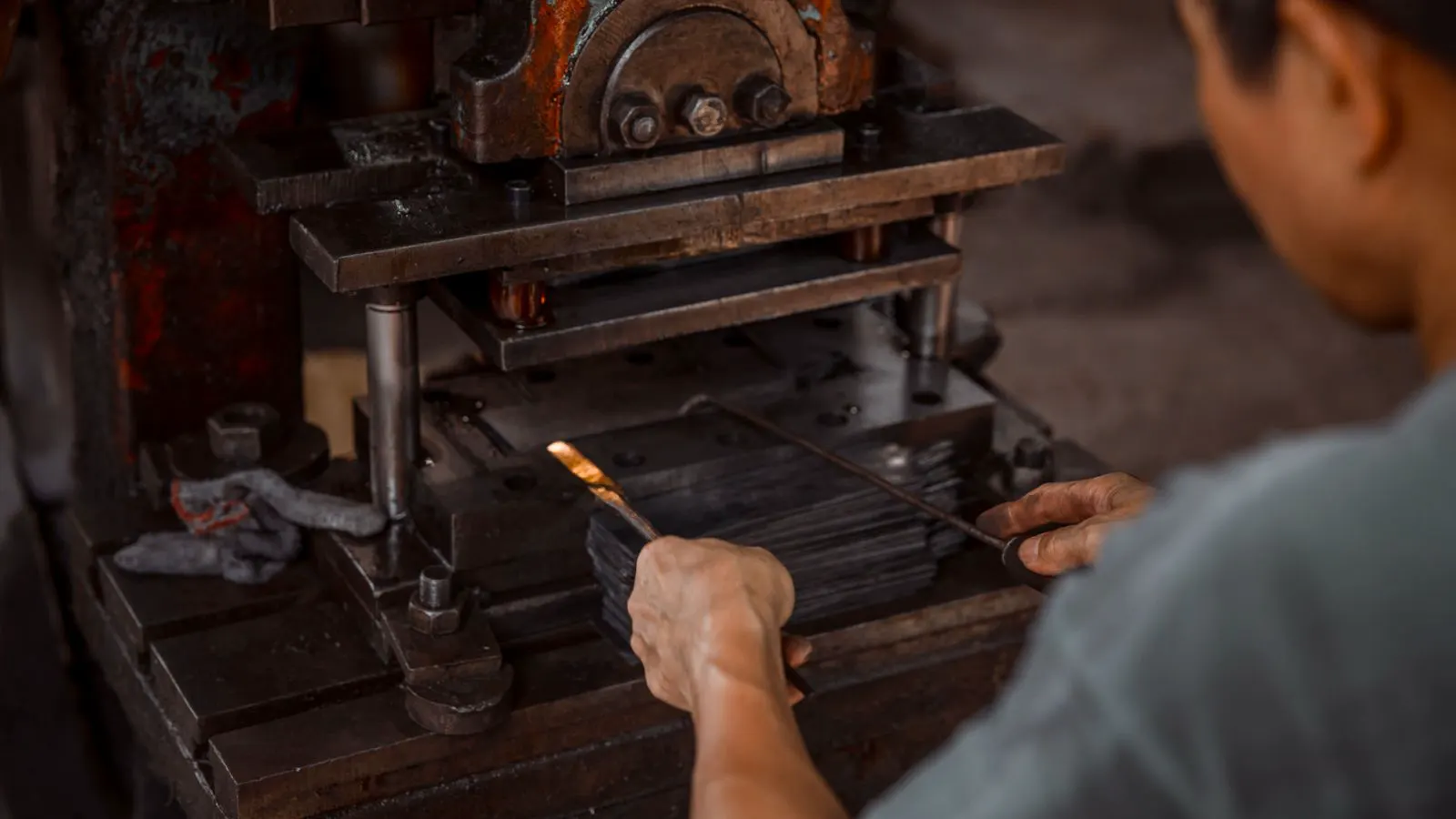
Sheet metal forming shapes flat stock into curved or three-dimensional parts without melting or removing material. This article explains the main methods, how they compare to fabrication, and how to evaluate forming capability when selecting a vendor.
- Sheet metal forming bends or shapes metal without removing material, unlike cutting or welding.
- The chosen method affects part geometry, tolerance, material limits, and tooling costs.
- Forming and fabrication are related but distinct; forming is one step within a broader production workflow.
- Ask vendors which forming method they use for your part and how it impacts tolerances.
- A clear RFQ should specify forming requirements, material thickness, and finish expectations.
What Is Sheet Metal Forming in Practice
Sheet metal forming is the act of shaping flat metal stock into a curved or three-dimensional shape without removing material. The metal is bent, pressed, or drawn by force until it takes the desired form. No material is lost in the process. The workpiece changes geometry, not mass.
This differs from cutting, which removes material to create edges or openings. It also differs from welding, which joins separate pieces together. Forming is a standalone step that changes the shape of a single piece. In many production runs, forming happens before or after other operations, but the definition stays the same.
When you specify a part, the forming method determines what is possible. A simple bend may use a press brake. A complex dome may require a spinning operation. A thin-walled container may be formed by deep drawing. The choice of method changes tooling, setup time, and the kind of quality checks your vendor can perform.
How Forming Differs from Other Fabrication Techniques
Fabrication is the broader term. It includes cutting, forming, welding, finishing, and assembly. Forming is one of the core steps inside fabrication.
Cutting removes material to define the outer shape. Forming changes the internal geometry of the already-cut piece. If you need a flat plate with a specific outline, cutting is the primary need. If you need that plate to curve, box, or wrap around a form, forming takes over.
Welding joins two or more pieces. Forming works on a single piece at a time. A welded bracket may require several flat pieces that are first cut, then bent, then joined. The forming step happens before the welding step.
There is overlap. Some processes combine forming and joining. For example, a tube may be cut to length, then welded at the seam, then formed into a curve. The forming step still applies to the tube. The definition of forming remains the same.
Main Sheet Metal Forming Methods
Different metal forming methods suit different part shapes and material conditions.
- Press Braking: A V-die and upper punch force the sheet into a bend. This is the most common method for angular bends. It is fast and repeatable. Tolerances depend on tooling and material behavior.
- Roll Bending: A series of rolls progressively bends the sheet into a long curve. This is suited to long profiles and repetitive curves. It handles longer spans than press brakes.
- Deep Drawing: A punch presses metal into a die to create a cup or box shape. The metal stretches and thins. This method suits deep, smooth-walled parts.
- Spinning: A rotating tool shapes the metal around a mandrel. This creates conical or hemispherical shapes. It is effective for large, smooth curves.
- Hydroforming: Fluid pressure shapes the metal against a die. This allows complex geometries with tight tolerances. It is used where shape complexity is high.
Each method has strengths and limits. Press brakes are economical for high-volume angular work. Deep drawing requires careful material selection to avoid cracking. Spinning works well for large radius parts. Hydroforming demands specialized equipment and setup.
How Forming Affects Sourcing Decisions
When you ask a vendor to quote a part, the forming step shapes the cost and timeline.
Tooling costs vary by method. Press brake tooling is often reusable across similar bends. Deep drawing dies may be part-specific. Spinning mandrels are often generic for a family of shapes. If your design changes, tooling cost changes. Ask which tooling is required and whether it is reusable.
Material thickness matters. Thin gauge sheet forms easily but may spring back or wrinkle. Thick plate resists bending and may require higher tonnage presses. The vendor must confirm the press capacity matches the material. A mismatch causes poor bends or equipment damage.
Tolerances depend on the process. Press brake bends can hold tight tolerances with good tooling and control. Deep drawing tolerances are looser on wall thickness but can be tight on diameter. Spinning gives smooth, continuous curves. If your part has critical dimensions, state them clearly in the RFQ.
Surface finish also plays a role. Forming can stretch the surface and reveal imperfections. If the part must look clean, the vendor may need to anneal the metal or apply a post-forming finish. Specify whether the formed surface is visible.
Worked Example: Forming a Panel
Consider a flat steel panel that must become a shallow, rectangular box. The panel is cut to size. The edges are bent upward to form the sides. The bottom stays flat.
The forming method here is press braking. The vendor loads the panel into a press. A punch presses down while the die supports the bottom. The edges bend up. The corners may be welded if the panel is made from separate pieces.
The buyer asks: What is the bend angle? What is the flat pattern? What is the springback compensation? The vendor answers with a flat pattern drawing. This drawing shows the flat shape before forming. It includes allowances for the metal stretching during the bend.
If the buyer changes the bend angle, the flat pattern changes. If the buyer changes the material thickness, the flat pattern changes again. The vendor must recalculate. This is why the RFQ must include material, thickness, bend angle, and tolerance.
Another example: a cylindrical tube. The tube is formed by roll bending or spinning. If it is a long pipe, roll bending is typical. If it is a short, deep cup, deep drawing may be used. The method changes the tooling and the setup time.
Common Mistakes When Specifying Forming
Buyers often confuse forming with fabrication in general. They ask for “fabrication” without specifying the forming step. The vendor may assume a standard bend. The part arrives with the wrong angle or the wrong radius.
Another mistake is ignoring material behavior. Steel, aluminum, and stainless steel form differently. Each has a different springback. The vendor needs the material grade to calculate the flat pattern. If the buyer only says “steel,” the vendor may guess.
Tolerance confusion is another issue. Buyers state tolerances without context. A tolerance on a bend angle is different from a tolerance on a flat dimension. State the tolerance on the specific feature.
Tooling assumptions are dangerous. Buyers assume the vendor already has the tooling. They do not. The vendor must quote the tooling. If the buyer does not ask, the tooling cost may be hidden in the base price.
How to Ask the Right Questions in an RFQ
A strong RFQ states the forming requirement clearly.
- What is the material and thickness?
- What is the final shape?
- What is the bend angle or radius?
- What are the critical tolerances?
- Is the formed surface visible?
- Is there any post-forming finish required?
- Is this a one-off or a production run?
The vendor should answer with a flat pattern or a forming drawing. This drawing shows how the flat sheet becomes the final part. It includes the tooling details and the setup steps. If the vendor cannot provide this, ask why.
The vendor should also state the forming method. If the method is not obvious, ask. For example, if the part has a long curve, ask if roll bending or spinning is used. If the part has a deep cup, ask if deep drawing is used.
How Forming Fits Into a Larger Production Plan
Forming is not a standalone operation in most shops. It sits inside a sequence. The sheet is cut. It is formed. It is welded. It is finished. It is inspected.
The order of operations matters. If you weld before forming, the weld heat may affect the metal. If you form before welding, the bend may be easier to access. The vendor should propose the order. If the buyer does not specify, the vendor decides.
Nearshoring and supply chain changes affect forming too. A local vendor may have limited forming capacity. A distant vendor may have specialized equipment. The buyer must balance cost, lead time, and capability. If the part requires a specific forming method, the vendor must have that method. If not, the part must be sent elsewhere.
Checking Forming Capability Before You Commit
Before placing an order, verify the vendor can handle the forming step.
Look for the equipment. Press brakes, rolling machines, drawing presses, and spinning setups are physical machines. If the vendor cannot show the equipment, ask for photos or a site visit.
Ask for examples. Request a part that is similar in material, thickness, and complexity. If the vendor has made it before, they know the process. If not, they may need to develop a new setup.
Review the quality checks. Forming has inherent variation. Springback, wrinkles, and stretch marks are possible. The vendor should state how they control this. Do they use tooling adjustments? Do they inspect every part? Do they use statistical checks?
If the vendor is vague on forming, that is a red flag. A competent fabricator understands forming. They can explain the method, the tooling, and the controls. If they cannot, find a vendor who can.
When to Use a Specialist
Some forming operations require specialized vendors. Deep drawing of complex containers may need a dedicated die shop. Hydroforming of large automotive parts may need a large press. Spinning of large domes may need a large mandrel.
If your part requires one of these methods, search for a vendor with that specific capability. Do not assume a general fabricator can handle it. A general fabricator may outsource the forming step. That is acceptable if you manage the handoff.
If you outsource forming separately from fabrication, the buyer manages the interface. The forming vendor delivers a formed part. The fabrication vendor receives it and does the rest. The buyer must specify the tolerance on the formed part. If the tolerance is too tight, the fabrication vendor cannot fix it.
Final Thoughts on Sheet Metal Forming
Sheet metal forming is the step that gives flat metal its shape. It is distinct from cutting and welding. It has its own methods, its own tooling, and its own quality considerations.
When you source a part, define the forming requirement. State the material, thickness, shape, and tolerance. Ask the vendor for the forming method and the tooling. Ask for a flat pattern or a forming drawing.
A clear specification reduces errors. It aligns expectations. It makes the quote accurate. It makes the part right the first time.
Forming is not a mystery. It is a set of physical processes. The metal moves under force. The shape changes. The result is a part. Your job as a buyer is to ask the right questions and choose a vendor who can answer them.
Frequently asked questions
What is the difference between sheet metal forming and sheet metal fabrication?
Forming is the step that shapes flat metal. Fabrication is the overall process that includes cutting, forming, welding, and finishing.
Can sheet metal be formed without removing material?
Yes. Forming changes the shape by bending, pressing, or drawing the metal. No material is removed during the forming step.
What is the most common sheet metal forming method?
Press braking is the most common method for angular bends. It is widely used for brackets, panels, and enclosures.
Does the material type affect forming?
Yes. Different metals have different springback and stretching behavior. The material grade must be specified so the vendor can calculate the flat pattern.
Do I need to specify the forming method in my RFQ?
You should describe the final shape and tolerances. The vendor should propose the method. If you know the method, state it to avoid assumptions.


